
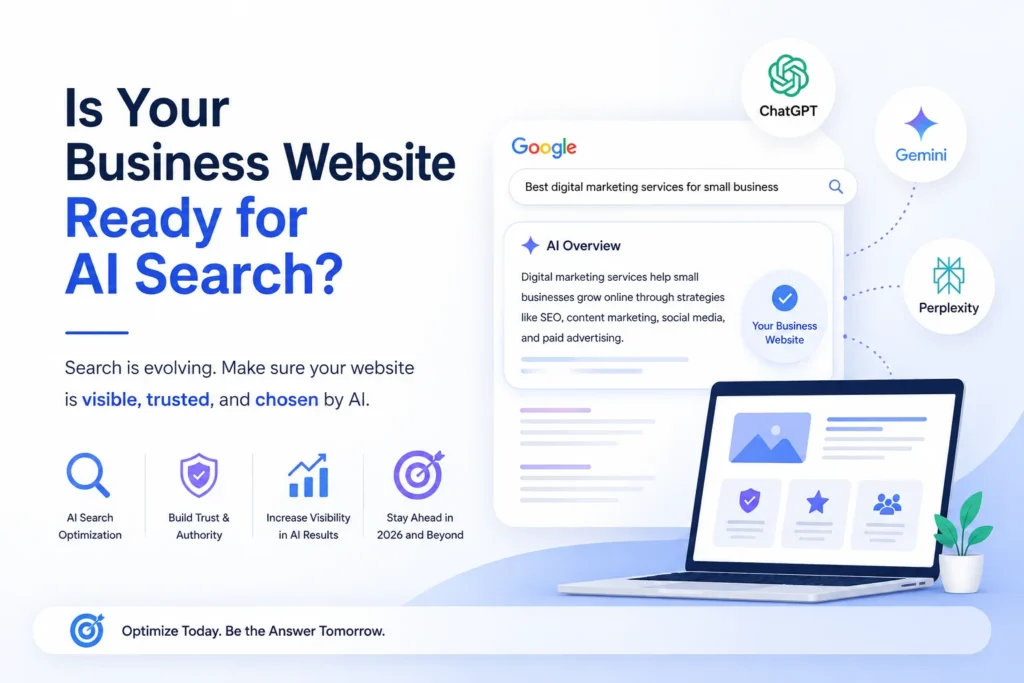
Is Your Business Website Ready for AI Search: Search is no longer what it was two years ago. Today, when someone asks Google a question, they often get a synthesized AI answer before they ever see a list of blue links. When they turn to ChatGPT, Perplexity, or Gemini, they get conversational responses drawn from across the web and your website either contributes to those answers, or it doesn’t.
If your digital marketing strategy still revolves exclusively around traditional SEO keyword rankings, backlinks, and meta tags you are already behind. AI-powered search engines are reshaping how information is discovered, cited, and trusted online.
This guide is your definitive resource for understanding AI search readiness. Whether you run a local service business, an e-commerce store, or a B2B company, you will learn exactly what AI search optimization means, why it matters more in 2026 than ever before, and the precise steps you need to take to ensure your website is visible in Google AI Overview, ChatGPT, Gemini, Perplexity, and every AI-powered search experience on the horizon.
Quick Answer Box: Everything You Need to Know at a Glance
What does “AI Search Ready” mean?
A website is AI search ready when its content is structured, authoritative, and semantically clear enough for AI models to extract, understand, and confidently cite its information in generated answers.
Why is AI search important?
AI-powered search engines now handle billions of queries daily. Google’s AI Overview appears in over 25% of all search results. Businesses not optimized for AI search are losing visibility to competitors who are.
Who needs AI search optimization?
Every business with an online presence — from solo consultants to enterprise brands. If your customers use Google, ChatGPT, Gemini, or Perplexity to find answers, you need AI search optimization.
Is AI search optimization worth it?
Absolutely. Websites that appear in AI-generated answers receive authoritative brand mentions, zero-click brand awareness, and qualified referral traffic — often at lower content competition than traditional SERP ranking.
What Does It Mean To Be Ready for AI Search?
Being ready for AI search means your website gives AI engines everything they need to understand, trust, and cite your content without ambiguity.
Traditional SEO helped your pages rank for keywords. AI search readiness goes deeper: your content must answer questions completely, demonstrate genuine expertise, be marked up with structured data, and reflect a clear, trustworthy brand identity. AI models are not just reading your words they are evaluating your authority, cross-referencing your claims, and deciding whether you are a credible source worth surfacing to a user.
An AI-ready website typically features:
- Clear entity identification — AI knows who you are, what you do, and where you operate
- Direct-answer content — Responses to user questions are provided immediately and concisely
- Structured data markup — Schema.org vocabulary helps AI parse your content accurately
- Demonstrable E-E-A-T — Experience, Expertise, Authoritativeness, and Trustworthiness signals are present throughout
- Semantic content architecture — Topics are covered in depth with related concepts naturally connected
- Conversational language — Content mirrors how users actually ask questions in natural language
Why AI Search Is Changing the Future of SEO
AI search is not a trend it is a structural shift in how information is accessed online.
According to data from BrightEdge (2025), AI-generated answers now appear in over 30% of Google searches globally, and that figure is growing month over month. Gartner has projected that by 2026, search engine volume will decline by 25% as users shift to AI-powered interfaces. Meanwhile, Semrush research found that branded traffic from AI sources is growing at nearly three times the rate of traditional organic traffic for businesses that have invested in answer optimization.
The Death of the “Ten Blue Links” Era
For decades, SEO was about ranking on page one. The measure of success was a position in the SERP, and traffic came from clicks. AI search changes this dynamic entirely. When a user asks Google’s AI Overview “What is the best CRM for small businesses?” and your company is cited in the synthesized answer, you receive brand exposure whether or not the user clicks through. This is zero-click authority a form of visibility that traditional SEO simply did not account for.
The Rise of Conversational and Intent-Driven Search
Modern users phrase queries the way they speak. “How do I fix a leaky faucet?” replaces “leaky faucet repair.” “What should I eat if I have high blood pressure?” replaces “high blood pressure diet.” AI engines are built for this conversational search behavior, which means content that mirrors natural language and directly addresses user intent is fundamentally more competitive in 2026.
AEO and GEO: The New Pillars of Search Visibility
Answer Engine Optimization (AEO) is the practice of structuring and formatting content so that answer engines including Google’s AI Overview, ChatGPT, and Perplexity can extract and present your content as a direct response to user queries.
Generative Engine Optimization (GEO) is a broader discipline focused on optimizing content for inclusion in AI-generated outputs across all generative AI platforms. Where AEO focuses on getting your answer cited, GEO focuses on shaping how AI understands and represents your brand, products, and expertise across the entire generative AI ecosystem.
Together, AEO and GEO strategies represent the next evolution of digital marketing and they reward the same thing: authoritative, clear, well-structured content.
How Google AI Overview, ChatGPT, Gemini, and Perplexity Find Answers
Each major AI-powered search platform retrieves and synthesizes information differently. Understanding these mechanisms is essential for targeted AI search optimization.
Google AI Overview
Google’s AI Overview (formerly Search Generative Experience) generates synthesized answers by pulling from pages that Google has already indexed and deemed highly authoritative for a given query. It strongly favors pages with structured data, concise factual content, strong E-E-A-T signals, and high Domain Authority. Pages that already rank in the top 10 for a query have the highest probability of being cited in AI Overview responses.
ChatGPT (with Browse and Search)
ChatGPT uses a combination of its trained knowledge base and real-time web browsing (via Bing integration) to answer questions. When browsing, it prioritizes content that is clearly structured, uses direct language, and comes from sources with strong domain trust signals. Markdown-style formatting headers, bullet points, numbered lists makes content easier for ChatGPT to parse.
Gemini
Google’s Gemini AI is deeply integrated with Google Search and Google’s Knowledge Graph. It pulls heavily from indexed web content, structured data (especially Schema.org markup), and Google Business Profile data. Gemini responds well to content that is semantically rich, uses entity relationships clearly, and is well-represented across the Google ecosystem (YouTube, Google Maps, Search Console).
Perplexity
Perplexity is a real-time AI search engine that always pulls from live web sources. It cites its sources explicitly in every response, which means appearing in Perplexity is particularly valuable for brand authority. Perplexity favors well-structured pages with clear headings, factual depth, and content that directly answers the query with specificity.
Signs Your Business Website Is Not Ready for AI Search
Identifying the gaps is the first step to closing them. Watch for these warning signs:
- Your content is vague and keyword-stuffed rather than specific and question-answering
- You have no structured data markup (no Schema.org JSON-LD on key pages)
- There is no clear “About” page with verifiable author credentials and company information
- Your content lacks direct answers you bury the response in long paragraphs with no clear structure
- Your website has poor mobile performance or slow page load speeds (Core Web Vitals failures)
- You have no FAQ sections or Q&A content that mirrors conversational queries
- Your brand has weak entity presence you are not mentioned or linked from authoritative external sources
- Content is shallow and not topically comprehensive you cover broad topics without real depth
- There is no HTTPS or other basic trust signals
- You have no consistent NAP (Name, Address, Phone) data across the web for local businesses
Essential Steps To Make Your Website AI Search Ready
Step 1: Build a Solid Entity Foundation
AI engines think in entities, not just keywords. Claim and optimize your Google Business Profile, create a Wikipedia or Wikidata entry if eligible, ensure consistent NAP data across directories, and add Organization Schema markup with your full brand details to your homepage.
Step 2: Implement Comprehensive Structured Data
Add Schema.org JSON-LD markup for every relevant content type: Article, FAQ, HowTo, Product, Review, LocalBusiness, Person, and BreadcrumbList. Structured data is the single most direct signal you can send to AI engines about your content’s structure and context.
Step 3: Create Direct-Answer Content Architecture
Restructure your key pages so that every major question is answered in the first 40–60 words after the heading. Use H2 and H3 headings that mirror real user questions. Include FAQ sections on every key page. Write in clear, simple, declarative sentences.
Step 4: Demonstrate Deep Topical Authority
Rather than writing one thin article per topic, build content clusters. A pillar page covering the main topic links to detailed supporting articles covering every subtopic. This topical depth signals to AI engines that your website is a comprehensive, authoritative resource.
Step 5: Strengthen E-E-A-T Signals
Include author bios with verifiable credentials. Add “Last Updated” dates to content. Earn citations and mentions from credible industry publications. Get genuine customer reviews published on Google, Trustpilot, or industry-specific review platforms.
Step 6: Optimize for Conversational Search
Audit your content to ensure it reflects how users actually speak. Use Google’s “People Also Ask” boxes, Answer The Public, and Perplexity’s auto-suggest to identify conversational queries your content should answer.
Step 7: Improve Technical Foundations
Ensure fast load times (LCP under 2.5 seconds), mobile responsiveness, HTTPS security, clean URL structure, and an XML sitemap that is regularly updated and submitted to Google Search Console.
Step 8: Build Brand Presence Across the AI Ecosystem
Create and maintain profiles on LinkedIn, Crunchbase, and industry directories. Publish guest articles on authoritative sites in your niche. Appear on podcasts or in interviews that get indexed online. Every authoritative mention strengthens your entity authority across AI models.
Common AI Search Optimization Mistakes
Many businesses rush into AI search optimization and make avoidable errors that undermine their efforts.
Mistake 1: Adding Schema markup without fixing the underlying content quality. Structured data helps AI parse good content it cannot rescue thin or inaccurate content.
Mistake 2: Writing for AI instead of humans. AI models are trained to surface content that genuinely helps people. Content that sounds robotic, overly optimized, or lacks real-world specificity performs poorly with both humans and AI engines.
Mistake 3: Ignoring local entity signals. For businesses with physical locations, local AI search visibility depends heavily on Google Business Profile, local citations, and geographic entity markup.
Mistake 4: Treating AEO and GEO as separate from SEO. The most effective approach integrates traditional SEO, AEO, and GEO into one unified content strategy. These disciplines reinforce each other.
Mistake 5: Neglecting content freshness. AI engines, particularly Perplexity and ChatGPT with Browse, prefer recently updated content. Old, stale pages rarely appear in AI-generated answers even if they once ranked well.
Comparison: Traditional SEO vs. AI Search Optimization
| Factor | Traditional SEO | AI Search Optimization |
| Primary Goal | Rank in SERP blue links | Get cited in AI-generated answers |
| Success Metric | Keyword position, organic traffic | AI citations, brand mentions, referral traffic |
| Content Format | Long-form keyword-optimized articles | Direct-answer, structured, entity-rich content |
| Key Signals | Backlinks, keywords, page authority | E-E-A-T, structured data, entity authority |
| Tools Used | Ahrefs, Semrush, Google Search Console | Frase, Surfer SEO, Schema validators, AI engines |
| User Query Type | Keyword-based (e.g., “best CRM”) | Conversational (e.g., “What CRM is best for a 10-person team?”) |
| Click Behavior | Depends on clicks | Value from zero-click brand mentions |
| Technical Focus | Core Web Vitals, crawlability | Structured data, semantic clarity, entity markup |
| Update Frequency | Periodically (quarterly) | Continuously (content freshness is critical) |
| Geographic Relevance | Local keywords and citations | Local entity signals, Google Business Profile |
Pros and Cons of AI Search Optimization
| Pros | Cons |
| Massive brand exposure via AI-cited answers | Less direct control over how AI represents your content |
| Zero-click brand awareness even without clicks | Requires significant content restructuring investment |
| Competitive edge over slower-moving competitors | ROI harder to measure than traditional keyword rankings |
| Builds long-term topical and entity authority | AI engine algorithms are not fully transparent |
| Works synergistically with traditional SEO | Requires ongoing content freshness and maintenance |
| Positions business as a trusted industry resource | Some industries face stricter AI content sourcing standards |
Benefits of Optimizing for AI Search
The upside of getting AI search optimization right is substantial and compounding.
Brand Authority at Scale: When ChatGPT, Gemini, or Google’s AI Overview cites your business as the source of an answer, it implicitly endorses your expertise to millions of users simultaneously. This kind of brand authority used to require years of PR efforts and media placements.
Qualified Traffic: Users who find your site via an AI-cited link have already received a synthesized answer. When they click through, they are typically highly motivated and further along in their decision-making journey, leading to higher conversion rates.
Competitive Differentiation: The majority of businesses are still operating on traditional SEO assumptions. Investing in AI search optimization now means positioning ahead of the curve before your competitors catch up.
Content Investment Longevity: High-quality, entity-rich, direct-answer content tends to remain relevant and citable for longer than thin, keyword-optimized content that loses relevance as search algorithms update.
| Tool | Primary Use | Best For |
| ChatGPT | Content drafting, conversational query research | Understanding how AI interprets your topics |
| Gemini | Entity research, Google ecosystem optimization | Identifying Google Knowledge Graph opportunities |
| Claude | Long-form content strategy, structured content drafting | Deep research, nuanced content architecture |
| Perplexity | Real-time query research, citation analysis | Identifying which sources AI currently cites |
| Semrush | Keyword research, content audit, competitor analysis | Comprehensive SEO and AEO strategy |
| Ahrefs | Backlink analysis, content gap research | Building entity authority through link signals |
| Surfer SEO | Content optimization, NLP keyword analysis | On-page semantic optimization |
| Frase | Answer-first content briefs, AI content scoring | Creating AEO-optimized content at scale |
Future of AI Search in 2026 and Beyond
AI search is accelerating, not plateauing. Several converging developments will define the search landscape over the next two to three years.
Multimodal Search: AI engines are becoming capable of processing images, audio, and video alongside text. Businesses that optimize visual content with alt text, transcripts, and structured metadata will gain significant advantages.
Agentic AI Search: AI agents systems that take actions on behalf of users, not just answer questions are beginning to emerge. An AI agent booking a restaurant, purchasing a product, or scheduling a consultation will rely on structured, machine-readable business data. Websites with robust Schema markup and API accessibility will be the ones agents interact with.
Real-Time Personalized AI Answers: As AI search platforms gather more user context, answers will become increasingly personalized. This will reward businesses with hyper-specific, niche-authoritative content over generic broad-topic coverage.
Voice and Conversational AI Integration: Smart speakers, in-car assistants, and wearable AI devices are extending the reach of conversational search. Content that answers questions in natural, spoken-language formats will gain new distribution channels.
The businesses that win in this environment are those that invest in genuine expertise, clear content architecture, and technical accessibility today not those who chase the latest algorithm update tomorrow.
People Also Ask
1. What is Answer Engine Optimization (AEO)?
AEO is the process of formatting and structuring website content so that AI-powered answer engines including Google AI Overview, ChatGPT, Gemini, and Perplexity can extract and present your content as a direct answer to user queries. It prioritizes concise answers, structured data, and question-based content organization.
2. What is Generative Engine Optimization (GEO)?
GEO is the broader practice of optimizing your online presence so that AI-generated content across all generative AI platforms accurately represents your brand, products, and expertise. It encompasses AEO but extends to brand entity building, knowledge graph presence, and cross-platform AI visibility.
3. How does Google decide what to include in AI Overview?
Google AI Overview draws primarily from pages that already rank well in traditional search results for a given query. It weighs E-E-A-T signals, structured data presence, content specificity, and domain authority. High-ranking pages with direct-answer formatting and Schema markup are most frequently cited.
4. Does structured data directly improve AI search visibility?
Yes. Structured data (Schema.org JSON-LD) provides AI engines with machine-readable context about your content what type of content it is, who created it, what it is about, and how it relates to other entities. This dramatically improves AI engines’ ability to understand and cite your content accurately.
5. How long does it take to see results from AI search optimization?
Unlike traditional SEO, which can take months for ranking improvements, AI search optimization can produce results more quickly particularly if your content already has domain authority. Many businesses see increased AI Overview citations and Perplexity mentions within four to eight weeks of implementing direct-answer content structures and Schema markup.
6. Is AI search optimization expensive?
The investment varies by business size and starting point. For most businesses, the highest-ROI activities restructuring existing content, adding FAQ sections, and implementing Schema markup require time investment from a skilled content strategist but not necessarily large budget outlays. Tools like Surfer SEO and Frase are affordable even for small businesses.
7. Can AI search optimization hurt traditional SEO rankings?
No the two disciplines are complementary. Optimizing for AI search typically improves the same signals that traditional SEO rewards: content quality, technical performance, E-E-A-T, and site structure. A well-executed AI search strategy tends to lift traditional rankings simultaneously.
8. What industries benefit most from AI search optimization?
Every industry benefits, but those where users regularly ask informational questions healthcare, legal, financial services, home services, e-commerce, technology, and education see the most direct impact. In these sectors, AI Overview and ChatGPT answers frequently cite authoritative industry sources, creating significant visibility opportunities.
Conclusion: The Window of Opportunity Is Now
The shift to AI-powered search is not approaching it is already here. Google AI Overview reaches hundreds of millions of users daily. ChatGPT handles over 100 million queries per day. Perplexity is growing at triple-digit annual rates. And every one of these platforms is actively deciding, in real time, which businesses to cite and which to ignore.
The good news is that this transition is still early enough that proactive businesses can establish themselves as authoritative AI-cited sources before their competitors even recognize the opportunity. The fundamentals of AI search readiness genuine expertise, clear content architecture, structured data, entity authority, and technical excellence are the same fundamentals that define outstanding digital marketing at any time.
Your website does not need to be rebuilt from scratch. It needs to be reimagined through the lens of AI search: every page asking, “Does this content give an AI engine everything it needs to confidently cite us as the best answer?”
Start with your highest-traffic pages. Add FAQ Schema. Restructure your intros to deliver direct answers immediately. Strengthen your entity presence. And keep improving because in AI search, the brands that commit to continuous, authoritative content will compound their advantage over time.
Key Takeaways
- AI search is already reshaping how users discover businesses online Google AI Overview, ChatGPT, Gemini, and Perplexity are now primary information sources for hundreds of millions of people daily.
- Being “AI search ready” means your content is structured, authoritative, and semantically clear enough for AI engines to extract and cite with confidence.
- AEO (Answer Engine Optimization) focuses on appearing in AI-generated direct answers; GEO (Generative Engine Optimization) focuses on shaping your brand’s representation across the entire generative AI ecosystem.
- Structured data (Schema.org JSON-LD) is the single most direct technical signal you can provide to AI search engines prioritize FAQPage, Organization, Article, and HowTo schemas.
- Direct-answer formatting concise, clear responses of 40–60 words immediately following each heading is the content structure AI engines most readily cite.
- E-E-A-T signals (Experience, Expertise, Authoritativeness, Trustworthiness) are the authority foundation of AI search; author credentials, third-party mentions, and genuine reviews all contribute.
- Traditional SEO and AI search optimization are complementary investing in one strengthens the other.
- The businesses that act on AI search optimization now will establish durable competitive advantages before this approach becomes mainstream.
FAQ Section
What does it mean for a website to be AI search ready?
An AI search ready website is one that AI engines can fully understand, trust, and confidently cite when generating answers for users. It features comprehensive structured data, clear entity identification, direct-answer content formatted around real user questions, strong E-E-A-T signals (Experience, Expertise, Authoritativeness, Trustworthiness), and technically sound performance. It does not rely on keywords alone it communicates context, authority, and relevance in ways that both humans and AI models can interpret clearly.
How is AI search different from traditional SEO?
Traditional SEO focuses on ranking web pages in keyword-based SERP listings and driving clicks. AI search optimization focuses on getting your content cited and synthesized within AI-generated answers often without a click occurring at all. Traditional SEO rewards backlinks and keyword density; AI search rewards genuine expertise, structured content, direct answers, and entity authority. Both approaches matter in 2026, but AI search is the faster-growing source of brand visibility and referral traffic.
What is Google AI Overview optimization?
Google AI Overview optimization is the practice of structuring content so that Google’s AI-generated search summaries (which appear at the top of many Google results pages) select your website as a cited source. Key tactics include implementing Schema.org structured data, writing concise direct-answer content after each H2 heading, demonstrating strong E-E-A-T signals, targeting question-based queries, and maintaining high traditional SEO authority since AI Overview sources primarily from top-ranking pages.
What is AEO and GEO in SEO?
AEO (Answer Engine Optimization) is the discipline of optimizing content to appear as direct answers in AI-powered answer engines like Google AI Overview, ChatGPT, and Perplexity. GEO (Generative Engine Optimization) is a broader discipline focused on ensuring your brand and content are accurately represented across all generative AI platforms including in training data, knowledge graphs, and real-time retrieval systems. Together, AEO and GEO form the foundation of AI search optimization strategy in 2026.
Can small businesses benefit from AI search optimization?
Absolutely. In fact, small businesses can gain disproportionate benefits from AI search optimization because AI engines reward topical depth and genuine expertise over sheer domain size. A local plumber who builds the most comprehensive, direct-answer content about plumbing issues in their area complete with FAQ Schema, local business markup, and verified reviews can appear in AI-generated answers ahead of larger national competitors who have not optimized for AI search.
How do AI-powered search engines choose websites?
AI-powered search engines evaluate multiple signals when selecting sources for generated answers: domain authority and trustworthiness, content relevance and specificity to the query, structured data markup, E-E-A-T signals (especially for health, finance, and legal topics), content freshness, and presence in authoritative external sources. For real-time systems like Perplexity, recency of publication is heavily weighted. For Google AI Overview, existing SERP ranking position is the strongest predictor of citation likelihood.
What structured data helps AI search visibility?
he most impactful Schema.org types for AI search visibility include: FAQPage (for question-and-answer content), Article and NewsArticle (for editorial content with author and publication data), Organization and LocalBusiness (for entity identification), Product and Review (for e-commerce), HowTo (for instructional content), BreadcrumbList (for site structure), and Person (for author authority). Implementing these in JSON-LD format in your page’s <head> tag is the recommended approach by Google.
Which AI tools help improve search rankings?
The most effective tools for AI search optimization in 2026 are: Frase for building direct-answer content briefs; Surfer SEO for semantic keyword and NLP optimization; Semrush for comprehensive keyword and competitor research; Ahrefs for backlink and entity authority analysis; ChatGPT, Gemini, and Claude for content drafting, question research, and content structure review; Perplexity for real-time citation research to see which sources AI currently cites for your target queries; and Google Search Console for monitoring AI Overview impressions and performance.