
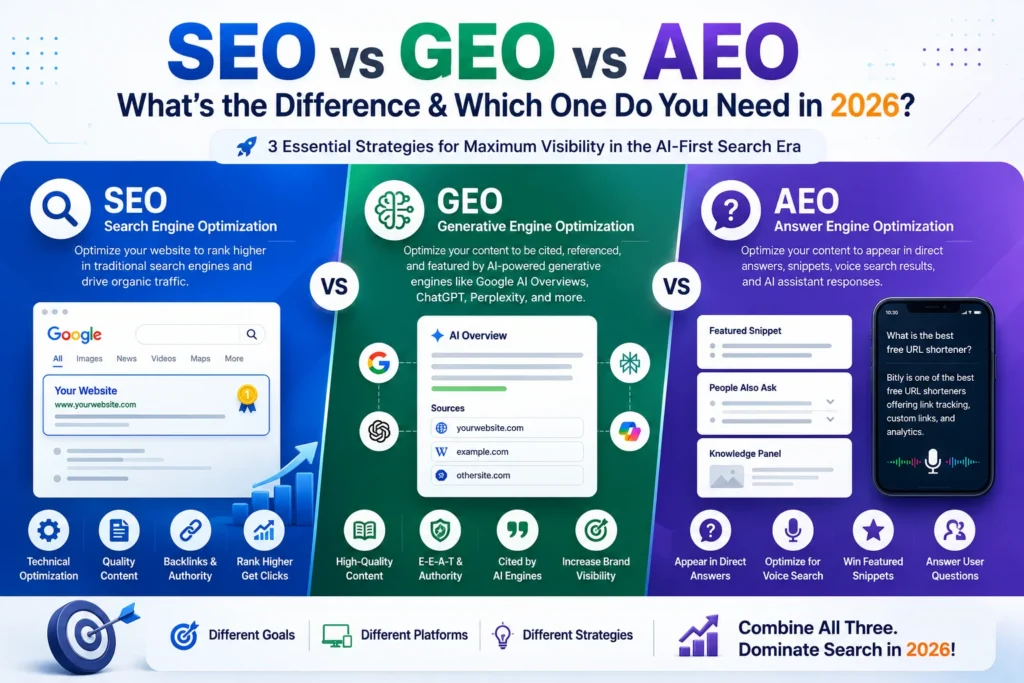
SEO vs GEO vs AEO, What’s the Difference & Which One Do You Need in 2026 : The world of digital visibility is changing fast. Just a few years ago, the only thing marketers needed to worry about was ranking on Google. Today, there are three distinct optimization strategies every website owner needs to understand: SEO, GEO, and AEO.
Each one serves a different purpose, targets a different type of search experience, and requires a different approach. If you’re only focusing on one, you’re leaving a significant amount of visibility and traffic on the table.
In this guide, we break down exactly what SEO, GEO, and AEO mean, how they differ, where they overlap, and most importantly which ones you need to be investing in right now.
What Is SEO (Search Engine Optimization)?
SEO: Search Engine Optimization is the practice of optimizing your website and content so that it ranks higher in traditional search engine results pages (SERPs), primarily Google, Bing, and Yahoo.
When someone types a query into Google and sees a list of blue links, everything that determines which links appear at the top and in what order is governed by SEO.
How SEO Works
Search engines use complex algorithms that analyze hundreds of ranking signals to decide which pages are most relevant and trustworthy for any given query. The three core pillars of SEO are:
| Technical SEO | On-Page SEO | Off-Page SEO |
| Site speed, mobile-friendliness, crawlability, Core Web Vitals, structured data, canonical tags. | Keywords, meta titles, meta descriptions, headings (H1–H4), content quality, internal linking. | Backlinks from authoritative sites, brand mentions, social signals, guest posting, digital PR. |
Key Goals of SEO
- Rank on the first page of Google for target keywords
- Drive consistent organic (free) traffic to your website
- Build domain authority and brand trust over time
- Generate leads, sales, and conversions from search traffic
Who Needs SEO?
Every website that wants to be found online needs SEO. It’s the foundation of digital visibility. Without SEO, even a great website will remain invisible to potential visitors.
What Is GEO (Generative Engine Optimization)?
GEO: Generative Engine Optimization is the emerging practice of optimizing your content to be cited, referenced, or featured by AI-powered generative search engines, such as Google’s AI Overviews, ChatGPT Search, Perplexity AI, Microsoft Copilot, and Claude.
Unlike traditional SEO where the goal is to rank as a clickable blue link GEO is about becoming the source that AI engines pull from when they generate their synthesized answers at the top of the search results page.
How GEO Works
Generative AI search engines don’t just return links — they read, analyze, and synthesize multiple sources into a single, conversational answer. GEO is about making your content the most credible, clear, and well-structured source for AI to reference.
Example:
A user searches: “What is the best free URL shortener?”
Instead of 10 blue links, Google AI Overview generates a paragraph summarizing the top options citing 2–3 sources. GEO is about being one of those cited sources.
GEO Optimization Tactics
- Write comprehensive, well-cited, factual content that AI engines trust
- Use clear structure: headings, bullet points, tables, and concise definitions
- Include statistics, data, and expert quotes to establish authority
- Cover topics with breadth and depth thin content rarely gets cited by AI
- Build brand authority so AI engines recognize your site as a credible source
- Optimize for E-E-A-T (Experience, Expertise, Authoritativeness, Trustworthiness)
Who Needs GEO?
GEO is critical for any brand that wants visibility in the AI-first search era. As Google AI Overviews, Perplexity, and ChatGPT Search capture more of the top search real estate, websites that are not optimized for GEO will see declining click-through rates even if their traditional SEO rankings remain strong.
What Is AEO (Answer Engine Optimization)?
AEO: Answer Engine Optimization is the practice of optimizing your content specifically to appear in direct answer formats within search results: Featured Snippets, Google’s People Also Ask boxes, Knowledge Panels, voice search results, and AI assistant responses.
AEO focuses on getting your content selected as the single, direct answer to a question rather than one of many results on a page. It is closely related to GEO, but has existed as a concept since the introduction of Google’s Featured Snippets and voice search.
How AEO Works
Google and other search engines increasingly try to answer user queries directly on the results page without the user needing to click through to a website. AEO is about structuring your content so it gets selected for these prominent answer positions.
| Featured Snippets | People Also Ask | Voice Search |
| Paragraph, list, or table answer shown at Position Zero above all organic results. | Expandable Q&A boxes that Google shows for related questions on the results page. | When Siri, Google Assistant, or Alexa reads an answer aloud, it pulls from AEO-optimized content |
AEO Optimization Tactics
- Target question-based keywords: who, what, when, where, why, how
- Add a structured FAQ section to every blog post (with FAQ Schema Markup)
- Write clear, concise definitions: answer questions in 40–60 words directly below the question heading
- Use structured data (Schema.org) FAQPage, HowTo, QAPage schemas
- Format answers as short paragraphs, numbered lists, or comparison tables
- Target long-tail, conversational queries that mirror how people speak to voice assistants
Who Needs AEO?
AEO is especially valuable for informational and educational content sites, e-commerce FAQ pages, local businesses, and any website that targets question-based queries. If your audience is asking questions related to your niche, AEO is what gets your answer in front of them instantly at position zero.
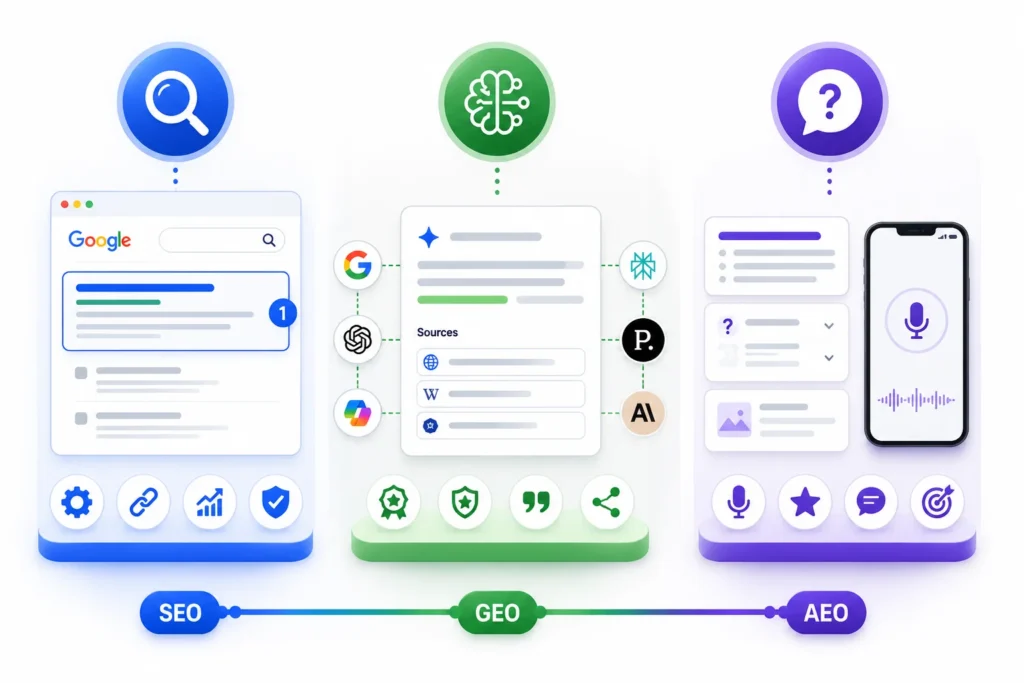
SEO vs GEO vs AEO — Full Comparison Table
Here’s a comprehensive side-by-side breakdown of how SEO, GEO, and AEO differ across every key dimension:
| Factor | SEO | GEO | AEO |
| Full Name | Search Engine Optimization | Generative Engine Optimization | Answer Engine Optimization |
| Primary Goal | Rank in Google blue link results | Get cited by AI-generated answers | Win Position Zero / Featured Snippets |
| Target Platform | Google, Bing, Yahoo SERPs | AI Overviews, Perplexity, ChatGPT | Google Snippets, Voice, PAA boxes |
| Content Type | Blogs, pages, product listings | Deep, comprehensive, data-rich content | Concise Q&A, definitions, how-tos |
| Key Tactic | Keywords + backlinks + technical | Authority + E-E-A-T + structure | FAQ schema + short direct answers |
| Result Format | Clickable blue link in SERP | Citation in AI-generated paragraph | Highlighted box above organic results |
| Voice Search | Indirectly supports voice | Moderately supports AI assistants | Directly optimized for voice answers |
| Maturity | Established 30+ years old | Emerging since 2023 | Growing since 2015 (snippets era) |
| Difficulty | High competitive, ongoing | Medium authority and depth required | Medium structure and clarity focused |
| Best For | All websites & businesses | Brands, publishers, thought leaders | Informational, FAQ, educational sites |
| Overlap | Foundation for both GEO & AEO | Builds on strong SEO foundation | Closely linked to both SEO & GEO |
The Key Differences Explained Simply
If you’re still confused about the difference between these three, here’s the simplest way to think about them:
SEO: “Make Google find me and rank me”
You optimize your website so that when people search on Google, your page appears in the list of results. The user has to click your link to reach you
GEO : “Make AI quote me as a source”
You optimize your content so that when AI engines like Google AI Overview or Perplexity synthesize an answer, they pull from your content and reference you as the source.
AEO: “Make Google show my answer directly”
You optimize specific content blocks so that Google highlights them as the direct answer in a Featured Snippet, People Also Ask box, or voice search result above all other results.
SEO, GEO & AEO Are Not Competitors They Work Together
The most important thing to understand is that SEO, GEO, and AEO are not competing strategies. They are complementary layers of a modern digital visibility strategy. Here’s how they stack on top of each other:
Layer 1= SEO (Foundation): Get your website technically sound, build domain authority, and rank for target keywords. This is the base everything else is built on.
Layer 2= AEO (Position Zero): Structure your content with FAQ schema, clear definitions, and direct answers to win featured snippets, PAA boxes, and voice results.
Layer 3= GEO (AI Visibility): Create authoritative, comprehensive, well-cited content that AI engines like Google AI Overview and Perplexity reference when generating answers.
In practice, a well-written, well-structured blog post like this one can simultaneously achieve all three goals: rank organically (SEO), get featured in snippets (AEO), and be cited in AI-generated answers (GEO).
Which Strategy Does Your Website Need?
The honest answer: in 2026, you need all three. But if you’re just getting started or have limited resources, here’s a priority guide:
| Your Situation | Top Priority | Also Do |
| New website / blog | SEO first build authority | Add AEO (FAQs) from day one |
| Informational / educational content | AEO target question keywords | GEO for AI citation |
| Established brand with traffic | GEO secure AI visibility | AEO for snippets |
| Local business | SEO (local SEO especially) | AEO for voice search |
| E-commerce site | SEO for product/category pages | AEO for FAQ pages |
| SaaS / Tech product | All three equally | GEO for thought leadership |
| Content / News publisher | GEO AI citation is critical | AEO + SEO |
Conclusion: The Future of Search Optimization Is All Three
The search landscape in 2026 is more complex and more opportunity-rich than it has ever been. SEO, GEO, and AEO each represent a different channel through which users can discover your content:
- SEO gets you in the traditional blue-link results that still dominate click volume
- AEO puts your answer in the featured position above all competition
- GEO ensures you’re cited by the AI engines that are reshaping how information is discovered
The websites and brands that will win the next decade of search are those that treat all three as integrated pillars of one unified content strategy not as separate silos competing for budget and attention.
Start where you are. Build your SEO foundation. Layer in AEO with structured FAQ content. Then invest in the depth and authority that GEO demands. The compounding effect of all three working together is greater than the sum of their parts.
Q1: What is the main difference between SEO and AEO?
SEO focuses on ranking your page as a clickable blue link in search results. AEO focuses on getting your content selected as the direct, highlighted answer shown above the organic results in Featured Snippets, People Also Ask boxes, or voice search responses. SEO drives clicks; AEO wins the answer box.
Q2: Is GEO the same as SEO?
No. SEO optimizes for traditional search engine result pages (SERPs) where users see a list of links. GEO optimizes for AI-powered generative search engines like Google AI Overview, Perplexity, and ChatGPT Search that synthesize answers from multiple sources. GEO is an evolution beyond classical SEO.
Q3: Do I need to choose between SEO, GEO, and AEO?
No you don’t need to choose. The three strategies are complementary, not competitive. Strong SEO builds the foundation. AEO helps you capture position zero and voice results. GEO ensures you’re cited by AI engines. The best digital marketing strategy in 2026 integrates all three.
Q4: How do I start with AEO?
Start by identifying question-based keywords your audience searches for (using tools like Google’s People Also Ask, AnswerThePublic, or Semrush). Write clear, concise answers to those questions directly in your content. Add FAQ schema markup (JSON-LD) to every blog post. Aim for 40–60 word definitions immediately below H2/H3 question headings.
Q5: What is GEO optimization in practice?
GEO optimization means creating content that AI engines trust enough to cite. In practice this means: building domain authority through backlinks and E-E-A-T signals, writing comprehensive content with clear structure, including verifiable statistics and expert insights, covering topics in depth, and ensuring your brand is recognized as a credible source in your niche.