
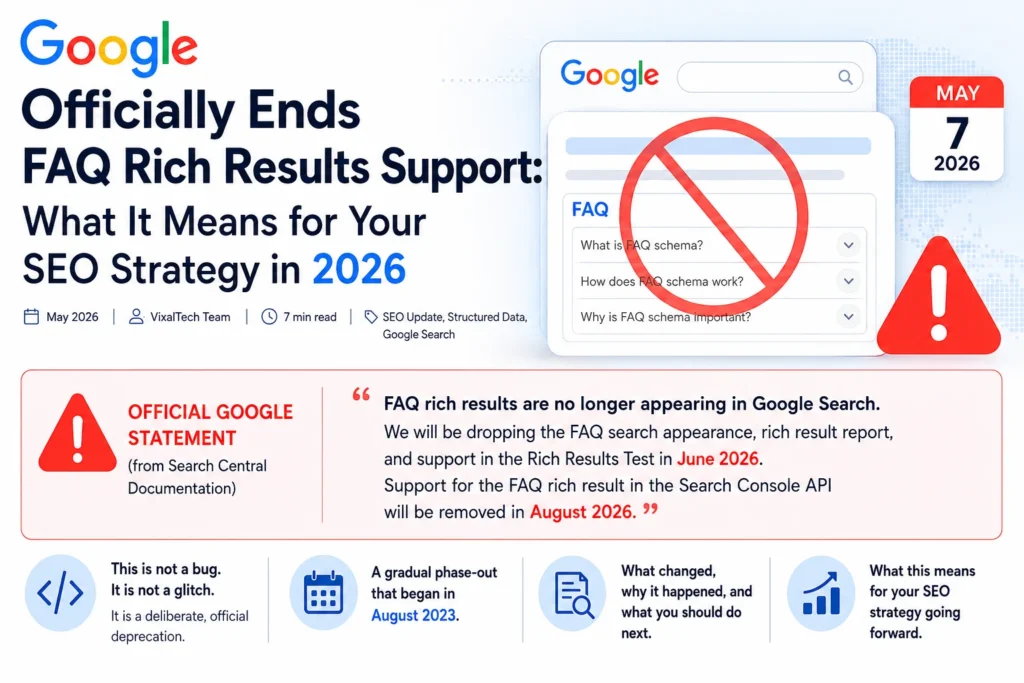
Google Officially Ends FAQ Rich Results Support: If you’ve spent time adding FAQ schema to your website pages to earn those eye-catching expandable question dropdowns in Google Search that era is officially over.
On May 7, 2026, Google officially ended support for FAQ rich results in Google Search. The expandable FAQ dropdowns that used to appear beneath search results giving websites extra SERP real estate and boosting click-through rates will no longer appear for any website, anywhere in the world.
This is not a bug. It is not a glitch. It is a deliberate, official deprecation announced directly in Google’s Search Central documentation, and it completes a gradual phase-out that began back in August 2023.
In this post, we break down exactly what changed, why Google made this decision, what you should do with your existing FAQ schema, and most importantly what this means for your SEO strategy going forward.
What Exactly Happened? The Full Story
To understand the May 2026 announcement, you need to understand that this was not a sudden change it was the final chapter of a story that started nearly three years ago.
The Complete Timeline
| Date | What Happened |
| 2015–2023 | FAQ rich results widely available for all websites. Adding FAQPage schema = instant extra SERP space for most sites. |
| Aug 2023 | Google restricts FAQ rich results to government and health websites only. 99% of commercial sites lose the feature overnight. |
| 2023–2025 | Only authoritative government and health sites retain FAQ rich results. All other sites see no benefit from FAQ schema in SERPs. |
| May 7, 2026 | Google officially ends FAQ rich results for ALL websites — including government and health sites. Feature is fully deprecated. |
| June 2026 | FAQ search appearance removed from Search Console. Rich Results Test stops supporting FAQ markup. |
| Aug 2026 | FAQ rich result support removed from Search Console API. All FAQ-related reporting infrastructure fully retired. |
Why Did Google End FAQ Rich Results?
Google has not provided a detailed public explanation for the May 2026 deprecation. However, based on Google’s past statements, industry analysis, and the broader direction of Google Search, there are several clear reasons driving this decision:
1. Widespread Spam and Schema Abuse
When FAQ rich results were available to all websites, the SEO community quickly discovered that adding FAQ schema was one of the easiest ways to dominate more SERP real estate. The result was predictable: millions of websites added low-quality, irrelevant FAQ sections purely to trigger the visual feature not to genuinely help users.
- Pages repeated the same templated FAQ blocks across thousands of URLs
- E-commerce sites inserted generic questions unrelated to specific products
- Keyword-stuffed FAQs were added to commercial landing pages as a ranking workaround
- Many FAQ answers were thin, copied, or misleading designed to fill pixels, not serve users
2. Google Is Moving Toward an Answer-First Model
The deeper strategic reason is Google’s pivot toward AI-powered, answer-first search. With Google AI Overviews now appearing in over 50% of searches, Google increasingly wants to serve answers directly on the results page synthesized by AI rather than routing users to individual websites for each question.
FAQ rich results were an early, clunky bridge between traditional search and answer search. They expanded a listing’s footprint but still sent users to the website. The new model AI Overviews synthesizes answers directly on the SERP. Removing FAQ rich results clears visual space and normalizes the idea that the search results page itself is where the answer lives.
3. Quality Control at Scale Was Impossible
With millions of websites implementing FAQ markup, Google faced an enormous challenge in ensuring that every displayed FAQ answer was accurate, helpful, and genuinely user-focused. Restricting to government and health sites in 2023 was an interim solution. Full deprecation in 2026 eliminates the quality assurance problem entirely.
What Does This Mean for Your Website Right Now?
Let’s be direct about what has changed, what has not changed, and what you actually need to do.
| What IS Gone | What Is NOT Gone |
| FAQ expandable dropdowns in SERPs | FAQ/Q&A content on your website pages |
| FAQ search appearance in Search Console | FAQPage schema as a valid Schema.org type |
| FAQ support in Rich Results Test | Google’s ability to understand your Q&A content |
| FAQ CTR boost from SERP real estate | AI Overviews citing your FAQ-structured content |
| FAQ rich result API reporting | Other schema types (HowTo, Product, Review, etc.) |
Should You Remove FAQ Schema From Your Website?
The short answer: you do not need to rush to remove FAQ schema from your pages. Here is a more nuanced breakdown of what to do:
Keep FAQ Schema If:
- Your FAQ content is genuinely useful and relevant to users on that page
- You want other search engines (Bing, DuckDuckGo) to potentially use it
- The content may help Google understand your page better for AI Overviews
- You have limited developer resources and removing it is not worth the effort
Remove FAQ Schema If:
- Your FAQ sections were created purely to trigger rich results and add no real value to users
- The FAQ content is duplicated across hundreds of pages sitewide with identical Q&As
- The questions are irrelevant to the actual page content pure keyword stuffing
- You want to clean up technical debt and simplify your structured data implementation
Does FAQ Schema Still Help With Google AI Overviews?
This is the most important strategic question and the answer is nuanced.
Google has explicitly stated that it will continue to use FAQ structured data to better understand pages, even though the rich result visual feature is gone. This is a critical distinction.
What this means in practice:
- Structured, clearly organized Q&A content helps Google’s AI systems understand the context and intent of your page
- Pages that Google understands clearly are more likely to be retrieved and cited in AI Overviews
- FAQ schema contributes to the ‘comprehension layer’ even without producing a visible SERP feature
- For GEO (Generative Engine Optimization) purposes, well-structured FAQ content remains valuable
Your Action Plan: What To Do Right Now
Here is a clear, prioritized action plan for every SEO professional and website owner in the wake of this update:
| # | Priority | Action |
| 1 | Immediate | Stop adding new FAQ schema purely for CTR. The visual benefit no longer exists. Any new FAQ content must serve users first. |
| 2 | Immediate | Update your SEO reporting dashboards. Remove FAQ rich result metrics they will disappear from Search Console in June 2026 anyway. |
| 3 | This Month | Audit your existing FAQ schema. Use the ‘practical test’ if the content adds genuine user value, keep it. If it was filler, remove it. |
| 4 | This Month | Stop using Rich Results Test for FAQ validation after June 2026. Shift testing focus to page-level performance metrics instead. |
| 5 | Strategic | Redirect your schema energy to structured data types that still drive rich results: HowTo, Product, Review, Recipe, Event, Article. |
| 6 | Strategic | Invest in GEO (Generative Engine Optimization). Write comprehensive, well-cited, authoritative content that AI Overviews will reference. |
| 7 | Strategic | Maintain FAQ content where it genuinely serves users. Clear Q&A structure still helps Google AI understand and cite your pages. |
| 8 | Strategic | Monitor your organic traffic from pages that had active FAQ rich results. If you see traffic drops, investigate other factors (content quality, backlinks). |
Alternative Schema Types That Still Drive Rich Results
FAQ schema may be losing its visual SERP impact, but structured data is not dead. Here are the schema types that still actively produce rich results in Google Search:
| Schema Type | Rich Result Format | Best For |
| Product | Price, availability, ratings stars | E-commerce product pages |
| Review | Star ratings in search results | Reviews, comparison articles |
| Article | Top Stories, enhanced article display | News, blog posts, editorial |
| HowTo | Step-by-step visual guide in SERPs | Tutorial, instructional content |
| Recipe | Cook time, calories, ratings in results | Food blogs, recipe sites |
| Event | Date, location, ticket info in results | Event listings, conferences |
| LocalBusiness | Knowledge panel, map integration | Local businesses, services |
| VideoObject | Thumbnail, duration in video results | YouTube embeds, video pages |
| BreadcrumbList | URL path shown in search results | All sites with clear structure |
| SitelinksSearch | Search box within Google results | Large authority websites |
Conclusion
Google’s decision to end FAQ rich results is not the end of FAQ content, structured data, or smart on-page SEO. It is, however, a clear signal about the direction Google is heading.
The SERP is evolving from a list of links into an AI-powered answer engine. The sites that will thrive in this new environment are those that create genuinely helpful, well-structured, authoritative content not those that add schema markup as a CTR trick.
Three things remain true after this update:
- Content quality still wins Google’s AI needs good sources to cite
- Structured data still matters just focus on schema types that still drive active rich results
- User intent still drives strategy write for people first, optimize for algorithms second
The FAQ rich result is gone. The opportunity to earn AI citation, featured snippets, and genuine organic authority is bigger than ever.
Frequently Asked Questions
Q1: When exactly did Google end FAQ rich results?
Google officially ended FAQ rich results on May 7, 2026. As of that date, FAQ expandable dropdowns no longer appear in Google Search results for any website including government and health sites that had retained them since the 2023 restriction.
Q2: Will removing FAQ schema improve or hurt my SEO rankings?
Neither, directly. FAQ schema removal does not cause a ranking penalty, and removing it will not improve your rankings. It is a structured data feature issue, not a ranking signal issue. Google has confirmed that unused structured data does not cause problems for Search. However, if your FAQ content is genuinely useful to users, keep it on the page regardless of schema.
Q3: Should I stop writing FAQ sections in my blog posts?
No. FAQ content that genuinely helps users should remain. What has changed is the visual SERP benefit — not the content value. Well-structured Q&A content still helps Google understand your page, may contribute to People Also Ask appearances, and can be cited by Google AI Overviews. Write FAQs for users, not for rich result features.
Q4: Does this affect People Also Ask (PAA) boxes?
No. People Also Ask (PAA) boxes are a separate SERP feature and are not affected by this change. PAA results are algorithmically selected from page content and are not directly tied to FAQPage schema markup. Your content can still appear in PAA boxes regardless of this update.
Q5: What is the difference between FAQ rich results and AI Overviews?
FAQ rich results were a visual SERP feature showing expandable Q&A dropdowns beneath a website’s organic listing driving users to click through to the website. Google AI Overviews are AI-generated synthesized answers at the top of search results that pull from multiple sources and may or may not send users to individual websites. Google is clearly prioritizing the AI Overview model over the traditional FAQ rich result model.
Q6: I had active FAQ rich results bringing traffic — will I lose traffic?
You may see a drop in CTR on pages where FAQ rich results were driving clicks. However, this depends on how much of your traffic was coming from the FAQ snippet interactions versus your standard organic listing. Monitor your Google Search Console performance data carefully over the next 30–60 days. If traffic drops significantly, focus on improving the organic listing itself title tag, meta description, and content quality.
Optimize Your Website for the AI Search Era
Use VixalTech’s free tools to improve your content, clean your links, and optimize every page. Explore All Free SEO Tools at VixalTech →